Receive FREE SHIPPING on orders over $99 placed on the Didax website and shipped within the contiguous US. No promo code is required to receive this offer.
The order total for free shipping is calculated after any discounts are applied. Orders containing any Eureka Math, Big Ideas, Zearn, Math Perspectives, Didax Classroom and/or Investigations Kits DO NOT qualify for free shipping.
Free shipping valid ONLY on orders placed on the Didax website shipped within the contiguous US. Our regular shipping policies applies to other orders.
Receive FREE SHIPPING on orders over $99 placed on the Didax website and shipped within the contiguous US. No promo code is required to receive this offer.
The order total for free shipping is calculated after any discounts are applied. Orders containing Eureka Math Kits DO NOT qualify for free shipping.
Free shipping valid ONLY on orders placed on the Didax website shipped within the contiguous US. Our regular shipping policies applies to other orders.
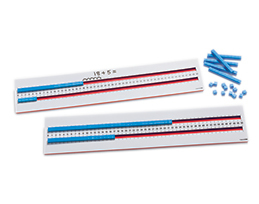
Double, or dual, number lines are an ideal "visual model" for solving mathematical problems involving equivalences, ratios, proportions, and more. Though double number lines are not mentioned specifically in the CCSS until Grade 6 (6.RP.3), they are a viable tool for mathematical understanding beginning as early as first grade.
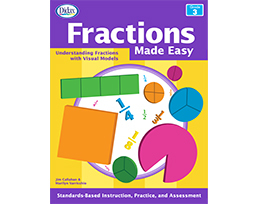
"Would you rather have half of one chocolate bar or a quarter of a different chocolate bar? Most popular answer: It depends on the size of the chocolate bars! As teachers know, the relative size of fractions depends on how the whole is defined. Authors Jim Callahan and Marilynn Varricchio address these common problems with fractions in their new book Fractions Made Easy (Didax, 2016). Drawing on material from the book, we will focus on how visual models can be used to support a solid conceptual understanding of fractions in third grade.
"With current math standards' emphasis on number lines as a visual math model, number lines are being used in nearly all primary grades classrooms for learning such things as counting and early operations. However, research has shown that number lines are conceptually too difficult for young children to understand and instead we should be using number paths, at least until second grade (Fuson, et. al., 2009). A number path is a visual model for counting, addition, subtraction and more. Experts say that the number path is superior to the number line as a visual model for early math learning. We caught up with Educator Margaret McGinty to learn why.
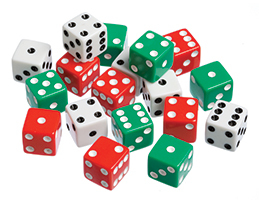
According to the American Statistical Association, "Effective prediction is essential to improving medicine; monitoring climate; providing sufficient, safe food supplies; and much more." To make educated predictions as adults, children need to understand probability -- and start learning about it at an early age. Prediction is an adult skill used in many professional fields, including science, medicine, finance, and insurance. Underlying prediction is the notion of probability: whether a given event is certain to happen, likely, unlikely, or impossible.
Success in school, the workplace, and society increasingly depends on our ability to comprehend informational text. Yet, despite current language arts standards, informational text often gets short shrift in primary grades classrooms. One study of 20 first-grade classrooms showed that nonfiction books constituted less than 10 percent of the classroom library and that students spent less than four minutes per day reading informational text. (Duke, 2000)
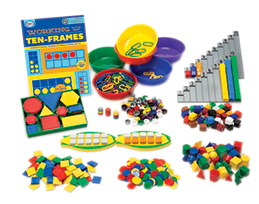
From a very young age, children learn and develop using all their senses. As infants they are surrounded by the stimulation of shape, color, lines, numbers, patterns, and textures. By the time they reach preschool, they are engaged in stories and imaginative pursuits that build on these sensory explorations. Thanks to the materials they have explored in their first five years, children already have a strong foundation for mathematics when they start kindergarten.



 © 2025 Didax, Inc. All Rights Reserved.