
Making your Number Line Work More Concrete
- By Alison J.
- Jan 14, 2020
By: Alison J. Mello
Assistant Superintendent - Foxborough Public Schools - Foxborough, MA
The Math Standards highlight number lines as a critical model to build flexibility and understanding, and we know that number lines can be used for a variety of concepts across grades. Unfortunately, students cannot interact with number lines in a way that allows them to touch and manipulate the parts the way they can with, say, Base Ten blocks or Rekenreks.
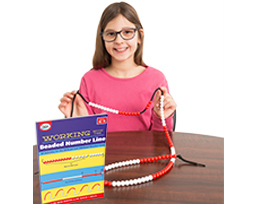
Enter the Beaded Number Line (BNL). This versatile new tool provides students with the tactile and concrete experience they have been missing with traditional number lines. The BNL allows students to build their understanding of number concepts, operations, rounding, decimals, and more by manipulating the beads that represent numbers and quantities.
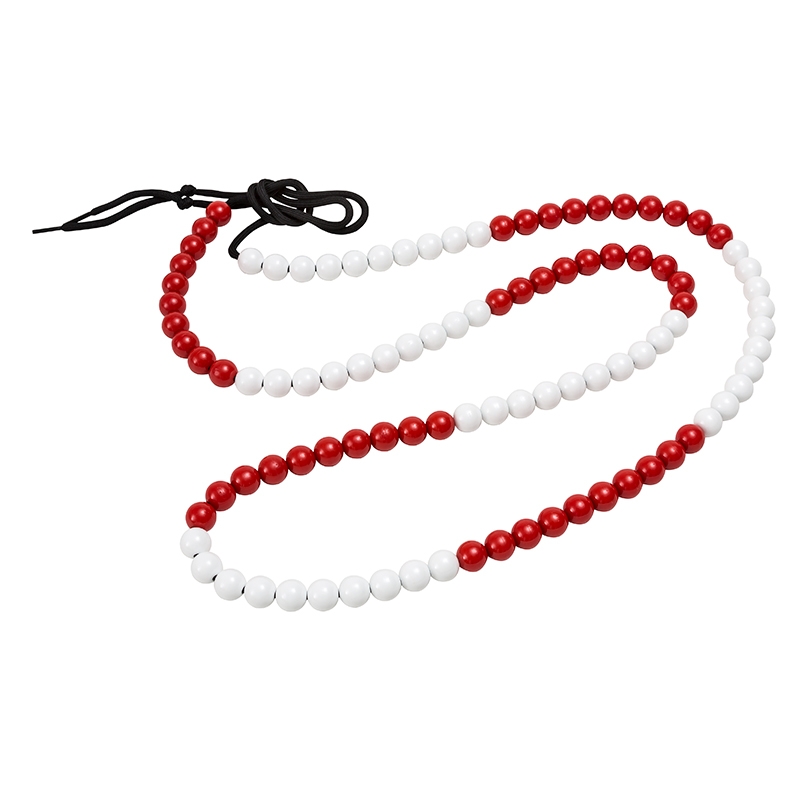
Work on the BNL should precede work on the traditional number line. Students need to become familiar with its structure (groups of 10 beads that alternate in color) so that they can develop efficient strategies such as counting by 10’s or groups of 10’s instead of 1’s. The bead string clearly shows that 100 is composed of 10 groups of 10. This allows students to easily identify 20 or 60, or see that 32 is 3 tens and 2 more. Using the BNL helps students to see why it is more efficient to make larger jumps on the open number line without losing the representation of the exact quantity represented by the jump.
Understanding Place Value and Operations
This tool is brilliant for place value and operations. Have you ever asked students how many 10’s in 108 and had them say “zero”? Holding up two BNLs to represent 108 will clearly show them that there are actually 10 groups of 10 in 108. They can just see it!
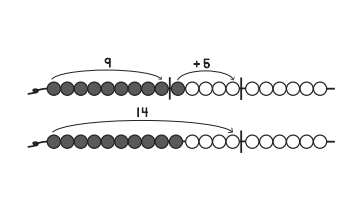
For addition, students find the first addend (part) and mark the spot with a clothes pin. They then identify the next addend (part) and place another clothespin after that quantity.To reveal the sum, they remove the first clothes pin and put the parts together to reveal the total. Subtraction operates in a similar way, with students either counting back or using a missing addend approach. With experience, students will begin to use strategies such as compensation and same difference. The ability to manipulate the beads makes these concepts much clearer and allows students to experiment.
Rounding and Beyond
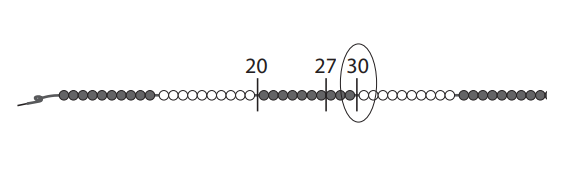
One of the best features of the BNL is that it makes rounding a snap! Say goodbye to riddles and tricks and simply have students mark the quantity you want to round to the nearest 10. For example, have students mark 27 with a clothespin and ask which 10 it is closer to, 20 or 30? Again, students can clearly see that 27 is closer to 30! So simple, and it makes math sense!!
For the upper grades, you can build understanding of multiplication, division, and even decimal fractions. Simply change the unit of the entire string to 1 and you have a concrete tool for decimals. With each individual bead representing 1/100 and each group 1/10, think of how easy it will be to find equivalents, add hundredths and tenths, and build understanding of the magnitude of these values!
From counting to fractions, the Beaded Number Line is a versatile tool that helps build students’ understanding of concepts in a visual, hands-on way. Want to learn more about the Beaded Number Line and see all of the cool things you and your students can do with it? Check out Working with The Beaded Number Line! I’m confident that it will be your new secret weapon for meaningful concept development in your classroom.
Want more activities & ideas for the Beaded Number Line?


 © 2025 Didax, Inc. All Rights Reserved.