
LEAP Q&A
- By Ashley D’Innocenzo
- Feb 25, 2020
In conjunction with researchers at the University of Texas at Austin and the University of Wisconsin-Madison, TERC has developed LEAP, Learning through an Early Algebra Progression. We were able to sit down with Maria Blanton, a Senior Scientist at TERC, to discuss the program.

We recognized that, generally, students are not prepared for the kind of math that they are doing in middle school and high school, and that algebra is really the gatekeeper for post-secondary education and entering the job market. We found that by spending just a little bit of time building early algebraic concepts in elementary grades, we can significantly improve children’s algebra readiness as they enter middle grades, and this has the potential to transform their success in school mathematics.
What makes LEAP different than other elementary programs?
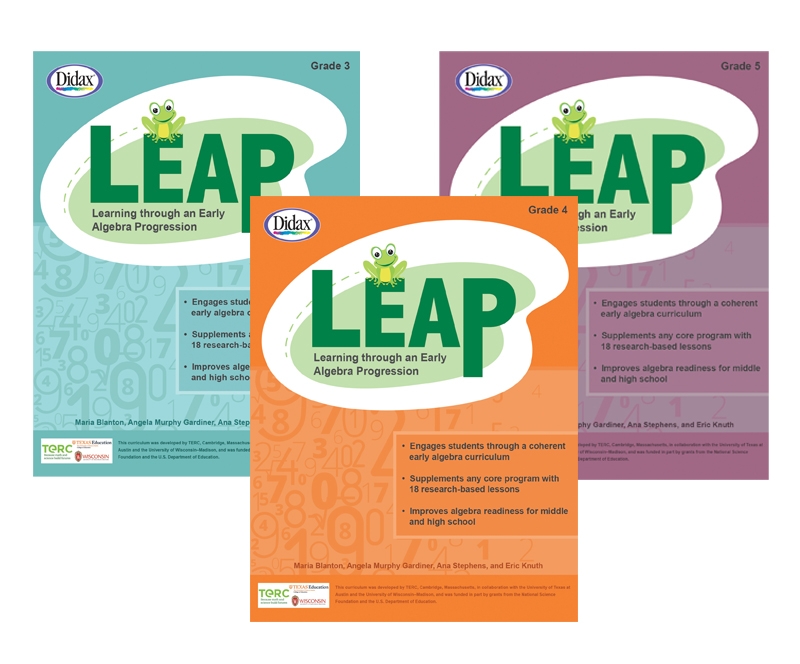
 LEAP is a supplemental program entirely focused on building early algebraic thinking, yet it does so by connecting with and deepening children’s understanding of arithmetic. It uses a series of tasks and activities to help children build their understanding of key algebraic concepts and practices over time. It is a first-of-its-kind resource that delivers authentic early algebra experiences for all learners: the lessons are coherent, the concepts are connected, the content is accessible, and the outcomes are transformative, increasing children’s readiness for learning formal algebraic concepts in later grades.
The title of the program talks about an “Early Algebra Progression.” What does this mean?
LEAP is based on extensive research in elementary classrooms that helped us design lessons that reflect how children’s algebraic thinking develops. We set out to build a program that would help students develop their understanding of early algebraic concepts gradually, over time. The lessons are connected across the grades, reflecting a progression of increasingly sophisticated concepts and practices. We focus on three big ideas: Equivalence, Expressions, Equations and Inequalities; Generalized Arithmetic; and Functional Thinking. These big ideas help us build the core algebraic thinking practices of generalizing, representing, justifying, and reasoning with mathematical structure and relationships.
What does a LEAP lesson look like?
 Each LEAP lesson provides the background information that teachers need to support learning in the classroom. We identify the outcomes of the lesson and also help teachers understand the rationale for the tasks that children will be engaged in. We start the lesson with a Jumpstart question to engage the students, and then provide instructions and prompts that help teachers guide children through the tasks. At the end of the lesson, a Review and Discuss prompt allows teachers to quickly check student understanding and provide correction and support when necessary.
For more information on the LEAP program please click below to learn more and shop now.







 © 2025 Didax, Inc. All Rights Reserved.