
Little Minds, Big Numbers: The Importance of Math in Preschool Classrooms
- By Christine Hopkinson
- Aug 4, 2025
Little Minds, Big Numbers: The Importance of Math in Preschool Classrooms
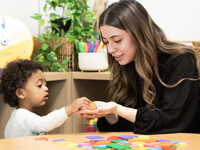
Hands-on math in preschool is about more than numbers—it’s about building curiosity, problem-solving, and essential thinking skills. From sorting and measuring to patterns and counting, playful activities lay the foundation for lifelong math success. These activities don't just teach math—they teach kids how to think.
Let’s count, sort, measure, and build our way into bright mathematical futures—one playful moment at a time!
Introduction
In the bustling world of preschool classrooms—where finger paints, storybooks, and building blocks reign supreme—math might not be the first thing that comes to mind. Yet, early childhood is a crucial period for building the foundation of mathematical thinking. Integrating math in preschool not only supports cognitive development but also fosters curiosity, problem-solving skills, and confidence in young learners.
Let’s explore why math matters in preschool, what key concepts to focus on, and how to weave it all together through play and hands-on activities.
Why Math in Preschool Matters
Research shows that early math skills are one of the strongest predictors of later academic success—even more than early reading skills. When children explore math concepts early on, they:
- Develop logical thinking and reasoning.
- Enhance their spatial awareness and fine motor skills.
- Learn to observe, compare, and categorize.
- Build persistence through problem-solving.
This doesn’t mean drilling equations; it’s helping children notice patterns, understand quantity, and recognize number relationships in everyday life.
Research: Early Numeracy as a Foundation
A recent study in the Netherlands highlights the crucial role of early numeracy in predicting future mathematics achievement. The study emphasizes that growth in early number competence is strongly associated with higher mathematics achievement later in life. This research reinforces the importance of developing number sense and providing support for children entering school with lower math achievement.
The Dutch study suggests that early numeracy development in education provides a strong foundation for later math achievement. More growth in early number competence was linked to higher mathematics achievement. The study underscores the importance of supporting students' number sense, especially for those entering school with lower math achievement.
Core Areas - Preschool & Transitional Kindergarten Math
- Number Sense
-
- Recognizing quantities without counting (subitizing).
-
- Understanding numbers, counting, and one-to-one correspondence.
- Patterns and Algebraic Thinking
-
- Identifying and creating patterns (AB, ABC sequences).
-
- Predicting what comes next in a sequence.
- Measurement
-
- Comparing lengths, weights, and volumes.
-
- Using nonstandard units (e.g., blocks or hands) to measure.
- Geometry and Spatial Sense
-
- Recognizing shapes and their attributes.
-
- Exploring positions, directions, and movement (e.g., above, below, next to).
- Data Collection and Sorting
-
- Sorting objects by attributes like color or size.
-
- Graphing simple data (e.g., favorite fruits or weather).
The Power of Play-Based Math
Young children learn best through play. When math is integrated into play, it becomes meaningful, engaging, and enjoyable. Here’s how:
- Block Play: Children naturally compare sizes, create patterns, and explore shapes as they build.
- Pretend Play: A grocery store setup can involve counting items, using money, and making comparisons.
- Outdoor Play: Counting steps, finding shapes in nature, and comparing leaves all encourage math talk.
- Songs and Rhymes: “Five Little Ducks” or “Ten in the Bed” teach subtraction and number sequencing.
Play provides context, language development, and social interaction—all essential for deep mathematical understanding.
Play-based Math: Sorting & Counting
Attribute-based sorting activities are critical for young children because they lay the foundation for essential cognitive and mathematical skills:
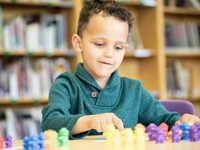
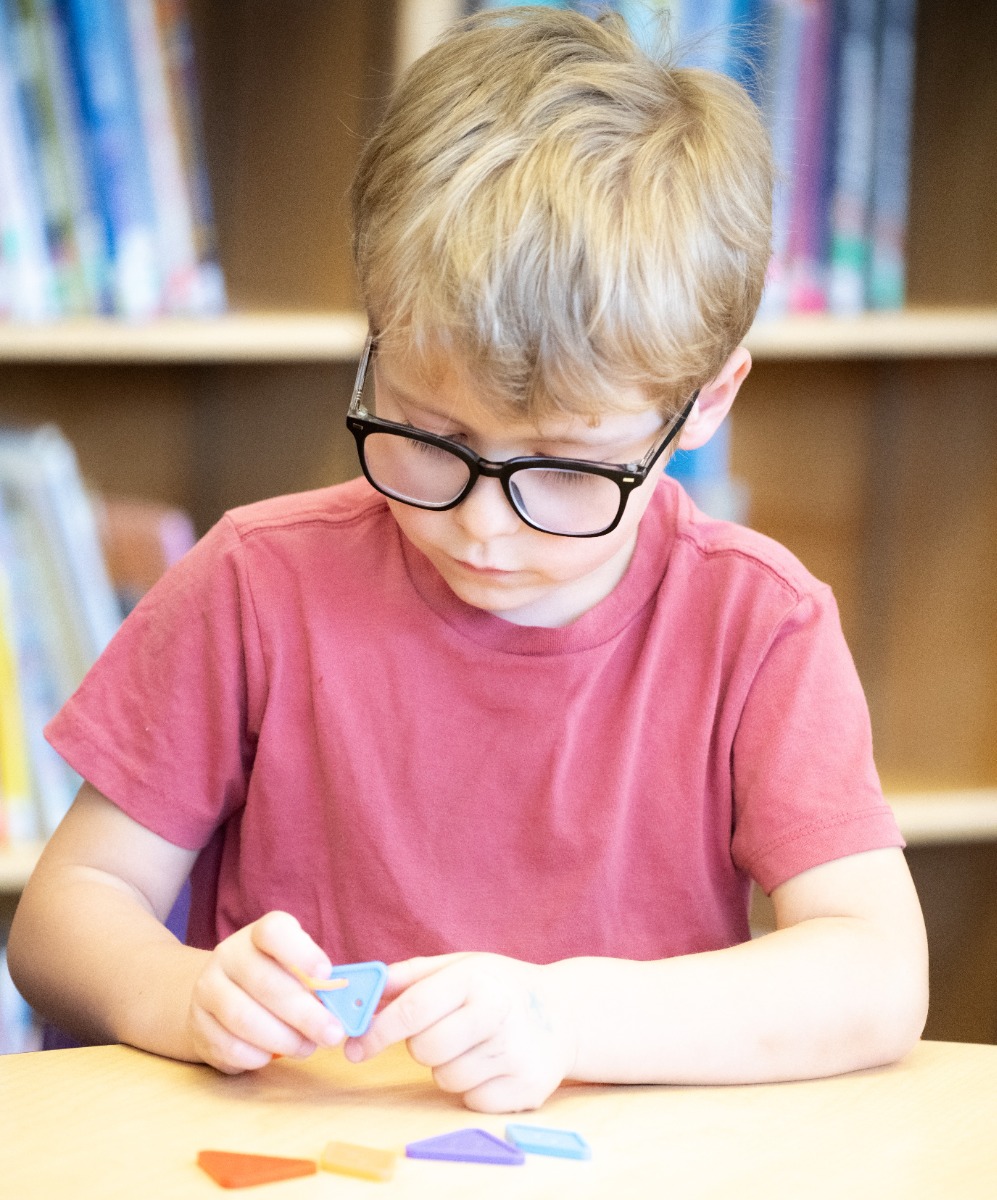
Builds Foundational Math Concepts: Sorting everyday objects (and math manipulatives such as) helps children recognize and understand attributes—such as color, shape, size, texture, or number of parts. These are the building blocks of:
- Classification (grouping similar things)
- Patterns (repeating sequences of attributes)
- Geometry (recognizing and describing shapes)
- Data organization (a precursor to graphing and charting)
- Counting & Comparison (understanding that sets of objects can be described with a quantity. “How many” and compared to one another)
Supports Cognitive Development: When children sort objects by different attributes, they develop higher-order thinking skills that transfer across subjects and everyday life.
- Observation: Noticing similarities and differences.
- Logical thinking: Deciding which category something belongs to.
- Problem-solving: Figuring out multiple ways to group items.
- Communication and Language:
- “This is round and red.”
- “These go together because they’re big.”
- “This one doesn’t belong—why?
- “There are 7 blue buttons and 9 red buttons. There are more blue buttons.”
As children explain their reasoning, they develop descriptive vocabulary and expressive language, both key parts of early literacy and social development.
Encourages Flexible Thinking: When children are asked to sort the same set of items in different ways (e.g., by color, then by size), they practice flexibility in thinking— things can be viewed from more than one perspective.
Simple Sorting Activities to Try:
- Use nature objects (leaves, rocks, flowers) for outdoor sorting.
- Create “Which One Doesn’t Belong?” sets of objects as a game.
Play-based Math: Patterns and Counting
Learning patterns helps children develop the foundational thinking that builds early algebraic thinking. Recognizing and understanding patterns is an introduction to solving equations. Here's a breakdown of why patterns matter so much in early childhood:
Develops Logical and Critical Thinking
- Reasoning: Why does the pattern go red-blue-red-blue?
- Predicting: What comes next in the sequence?
- Analyzing: What changes and what stays the same?
Supports Number Sense and Counting
- Skip counting (2, 4, 6, 8...) is a number pattern.
- Odd and even numbers follow a pattern.
- Base-ten understanding (place value) relies on recognizing predictable patterns in numbers.
Enhances Memory and Attention
Recognizing and extending patterns requires children to pay attention to details and remember sequences. These are important cognitive skills that support all areas of learning, especially in math and reading. Patterns are everywhere—not just in math. They’re in:
- Rhyming words (cat, hat, bat),
- Story structures (first, next, then, last),
- Songs and rhythms (clap-clap-stomp, clap-clap-stomp).
Examples of Pattern Activities for Preschoolers
- Pattern Necklaces: Use colored beads, coins, small food items, in repeating sequences.
- Clap-Tap Games: Repeating rhythmic movement patterns.
- Art Patterns: Making a red-blue-red-blue stamp painting.
Patterns are the heartbeat of mathematics, and giving children early access to them empowers them to become confident, curious, and capable math thinkers.
More Hands-On Math Activities That Work
Here are a few teacher- and parent-friendly activities that make math come alive in preschool:
- Counting Collections: Fill jars or bags with small items (buttons, beads, or cotton balls). Provide number cards and have children match to the correct quantity. Children may take out each item out and place on a number path to support one-to-one correspondence and cardinality.
- Shape Hunts: Go on a scavenger hunt to find circles, triangles, squares, etc. Have students tally and count what they see.
- Measure Me: Use Centimeter Linking Cubes to measure students' heights, hands, arms, legs, etc. (or the length of home/classroom items). Compare lengths and heights.
- Graph It: Create a simple bar graph with Jumbo Unifix Cubes based on children’s favorite animals, snacks, or colors using stickers or drawings.
- Dice Games: Roll dice and build towers with corresponding blocks. Great for counting and comparing.
Math in preschool is more than numbers on a worksheet—it’s about nurturing curiosity, observation, JOY, and discovery. When children experience math through playful exploration and hands-on learning, they develop a positive attitude and a solid foundation for future academic success.
Do your PreK & TK classrooms need a comprehensive set of lessons and materials to accomplish all this? Our Pre-K & TK Math Activity Kits are designed to playfully engage young minds with over 20 foundational math concepts, including counting, comparison, teen numbers, operations, geometry, measurement, patterns, and data. Each kit includes dozens of fun, high-quality manipulatives that make learning an exciting adventure.

 © 2025 Didax, Inc. All Rights Reserved.