
Making Math Stick: How Manipulatives Boost Learning Across Grade Levels
- By Lily Janson
- Oct 9, 2025
Making Math Stick: How Manipulatives Boost Learning Across Grade Levels
Children make sense of the world through sight, sound, touch, and movement. Decades of cognitive and neuroscience research show that sensory experiences form the foundation for abstract thought, including mathematical reasoning. When children explore, sort, build, and compare, they develop the brain pathways that later support number sense and problem solving (Butterworth, 2019; Sarama & Clements, 2021). This idea, often called embodied cognition, highlights how physical experience shapes mental understanding. In mathematics, hands-on learning is essential.
Early Learning: Math Begins with the Senses
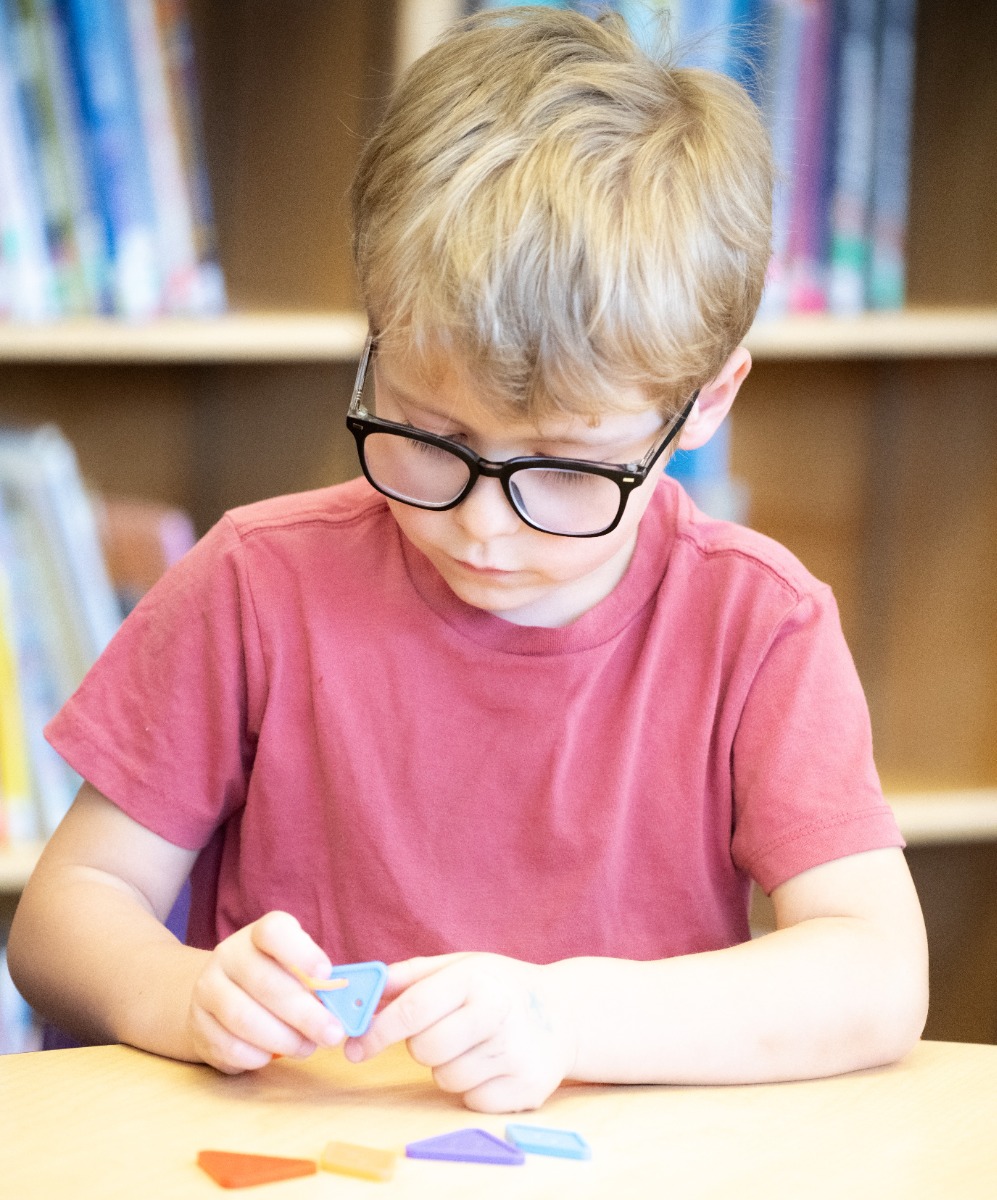
By preschool, children are already immersed in sensory-rich experiences involving color, shape, pattern, and texture. These experiences build perceptual and spatial awareness, which is critical for mathematical thought. Sorting blocks, matching socks, or building with tiles naturally supports one-to-one correspondence, pattern recognition, and spatial reasoning, all key early math skills.
Educational frameworks reinforce this approach. The National Council of Teachers of Mathematics (NCTM) emphasizes that mathematical ideas should be explored through multiple representations, including physical models, drawings, and symbolic expressions (NCTM, 2014). Similarly, the National Research Council identifies conceptual understanding and procedural fluency as equally important strands of mathematical proficiency, both strengthened through concrete and visual experiences (National Research Council, 2001).
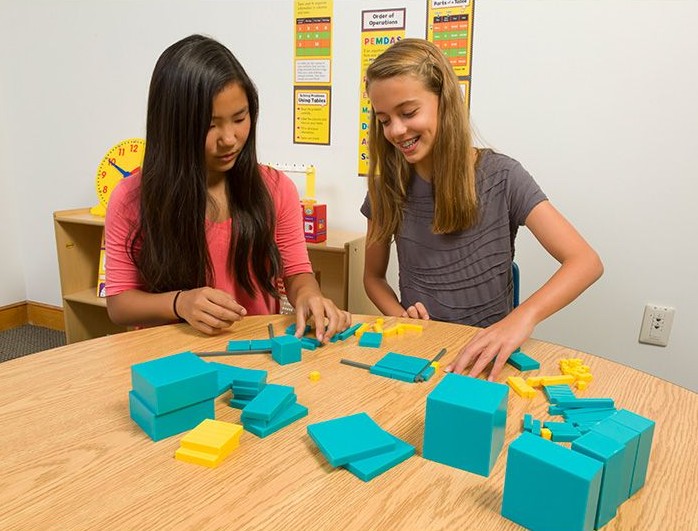
In classrooms, manipulatives such as Unifix Cubes, counting bears, Rekenreks, pattern blocks, and base ten blocks help children visualize number relationships. Everyday items such as dice, cards, coins, and buttons can also support low-cost, playful math exploration. The goal is to make abstract ideas tangible and connected to real experience.
Visual Models in the Primary Grades
As students progress through Grades K–2, visual and tactile models become even more important. Studies show that students who use manipulatives develop stronger number sense, problem-solving abilities, and conceptual understanding than those taught only through symbolic methods (Carbonneau, Marley, & Selig, 2013).
Tools such as ten frames, hundred charts, number lines, clocks, and base ten blocks help children see mathematical structure. These visual representations support understanding of place value, relationships among operations, and the meaning of written numerals and symbols.
Using fingers as a counting tool also supports number processing and is a sign of active sense-making rather than immaturity (Carbonneau, Marley, & Selig, 2013). Encouraging physical and visual engagement builds confidence and supports diverse learning needs.
Mathematics content and practice standards encourage students to use mathematical tools and representations to explore, model, and explain their thinking. Reasoning, communication, and modeling are often nurtured through sensory and visual experiences.
Upper Grades: Continuing Hands-On Support
For older students, instruction often shifts toward pencil-and-paper tasks. Many students, however, continue to rely on visual and kinesthetic support. Research shows that continued use of manipulatives in upper elementary and middle school improves retention, accuracy, and conceptual flexibility (Moyer-Packenham & Westenskow, 2013).
For example:
- Base ten blocks and place-value disks help students visualize place value concepts, including decimals, and develop conceptual understanding of operations.
- Fraction bars, tiles, and circles clarify part–whole relationships and clarify complex operations with fractions.
- Geoboards and pattern blocks promote geometric reasoning, area understanding, and proportional thinking.
- Two-color counters, number lines, and integer beads support students in mastering integer operations.
Real-World Math Connections
Hands-on math is most powerful when students apply their learning in real contexts.
- Money: Handling and exchanging coins strengthens place-value understanding and flexible problem solving.
- Time: Reading both analog and digital clocks reinforces fractions, skip counting, and elapsed time.
- Measurement: Using scales, rulers, and measuring cups anchors abstract units in tangible experience.
These activities align with the National Assessment of Educational Progress (NAEP) framework, which emphasizes applying mathematical reasoning in practical contexts. Engaging cognitive and sensory systems simultaneously deepens learning and retention.
The Takeaway
Mathematics is more than a language of symbols; it is a system for describing patterns, quantities, and relationships that children first encounter through play and perception. Hands-on learning builds neural and conceptual foundations for lifelong math understanding. Even as students grow older, visual and tactile tools remain critical. They foster reasoning, support diverse learning styles, and bridge the transition to abstract thinking. Quality manipulatives and interactive materials are essential for effective math instruction across all grade levels.
Work Cited
Butterworth, B. (2019). The Mathematical Brain. Penguin.
Carbonneau, K. J., Marley, S. C., & Selig, J. P. (2013). A meta-analysis of the efficacy of teaching mathematics with concrete manipulatives. Journal of Educational Psychology, 105(2), 380–400.
Moyer-Packenham, P. S., & Westenskow, A. (2013). Effects of virtual manipulatives on student achievement and mathematics learning. International Journal of Virtual and Personal Learning Environments, 4(3), 35–50.
National Council of Teachers of Mathematics (2014). Principles to Actions: Ensuring Mathematical Success for All.
National Research Council (2001). Adding It Up: Helping Children Learn Mathematics.
Sarama, J., & Clements, D. H. (2021). Learning and Teaching Early Math: The Learning Trajectories Approach. Routledge.
Uttal, D. H., et al. (2018). The malleability of spatial skills: A meta-analysis. Psychological Bulletin, 144(4), 337–366.

 © 2025 Didax, Inc. All Rights Reserved.