

Choo Choo! All Aboard: May Train Fun in PreK-3 Mathematics!
- By Christine Hopkinson
- May 10, 2024
All aboard! We hope you got a chance to celebrate National Train Day on May 11th!
We know children are naturally fascinated by trains. Take advantage of this fun event in your classroom this month with a high-leverage math tool, Ten-Frames Trains. Make the concept of ten concrete for your learners with these fun, interlocking "train" cars that hold 10 counters per train. Connect trains together to work with numbers to 20 and beyond.
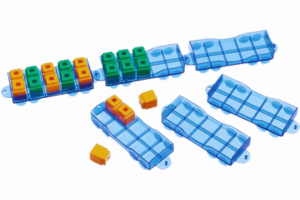
Ten-Frames: Foundational Math Tool
A ten frame is a concrete or pictorial representation that helps students visualize numbers related to the benchmark number, 10. At first, students use a ten-frame to work with numbers less than 10. For example, they see that 3 is 2 less than 5 and needs 7 more (2 and 5) to make 10, or 6 is 1 more than 5 and 4 less than 10. These compositions and decompositions of numbers 2-9 and especially partners of 10 are foundational to mental math (addition and subtraction). Ten frames also support what we often refer to as the “tricky teens”, helping students to conceptualize teen numbers as 10 and some more ones. Using more than one ten frame to represent 2-digit numbers develops the understanding that numbers are composed of tens and ones. This is a foundational concept of place value work and operations with larger numbers.
Active, Engaging, Mathematical Activities with Didax Ten-Frame Trains
Here are some classroom-tested (and student-loved!) Ten-Frame Train activities for various grades’ key mathematical concepts:
- PreK-K: Counting Train: Create a train representing the numbers 1-10 in order by placing 1 cube (or other counter) in the first car, 2 cubes in the second car, etc. Place the counters starting in the first square of the top row (or left column) to support visualizing each number as compared to benchmark numbers 5 and 10. Consider using a different color for each number.
- PreK-1: Sorting Train: Sort a set of Unifix Cubes, Teddy Bear Counters or Attribute Buttons by color, shape, or size into cars or trains.
- PreK-1: Counting Collection Train: Use cars and/or trains to organize and count a collection of small objects.
- K-1: Tens Trains: Fill ten cars with 10 cubes (or other counters). Connect the cars while counting by 10’s - 10, 20, 30, 40, etc.
- PreK-1: Teens Trains: Fill one car and part of another car to represent a teen number such as 12. Make all the “Teens Trains” 11-19 and line them up in order.
- K-1: Equal Train: Represent the same number in train cars using 2 or more different color cubes (or other counters). For example, a 5 train may have the following cars: 5 blue, 1 red and 4 blue, 2 red and 3 blue, etc.
- PreK-2: Compare Trains: Build two different trains, which is greater than? less than? For example, train 1 has 2 full cars and 1 car of 3 counters and train 2 has 1 full car and 1 car of 9 counters. Build more trains and order them from least to greatest.
- K: 100 Train: Students make various trains of 10 full cars using 100 counters or items.
- K-2: Skip Count Trains: Build a train with 2 or more cars – count the counters in the ten-frames by 2's (squares side by side), 5's (rows), 10's (ten-frame) to 20, 50, 100.
- 1-2: 10 More/10 Less Trains: Build a Ten Train (for example, represent 30) and either take a car of 10 away or add a car of ten.
- 1-2: Add/Subtract Multiples of Ten: Combine Tens Trains to add (for example, 20 + 30 = 50) or take some cars away from a Tens Train to subtract (for example, 50 – 20 = 30).
- 1-2: How Many More to Next Ten Train?: Build a train (1 or more cars) and leave the last car partially filled. State the number the train represents (i.e., 7, 17, 27, etc.) and find out how many more cubes are needed to fill the train (3).
- PreK-3: Pattern Trains: Build trains with counters to show different patterns ABAB, AABAAB, ABCABC, etc.
- K-2: Addition or Subtraction Trains: Put counters in 2-4 cars to represent addends (for example, 2 + 5 or 3 + 6 + 4). Connect cards to make a train and find the total. Students may move the counters to fill cars and make a ten as an efficient addition strategy. To represent subtraction, build a train with counters that represent a total, take away some, and determine how many counters are left. Consider taking from ones vs. taking from a ten when subtracting. Build and compare two different trains to represent different problems. For example, how many more counters are in a train of 12 than a train of 6? Dice or our virtual spinners may be used to generate numbers.
- K-2: Data Train: Use train cars as "bars" to represent 3 or more categories of data collected (color shirts, favorite snacks, bus/car/walk, etc.).
- K-2: Money Train: Put coins (same type or different) in 1 or more cars and find the total value of the train.
- 2-4: Multiples Train: Put equal groups of counters in each of 2-10 cars. What is the train total? How do we know? Use repeated addition, skip counting, distributed property, etc.
- 3-4: Division Train: Take a total (36 cubes) and put them in an equal number of groups/cars (6 cars). How many in each car?
- 4-5: Decimal Trains: A 10 car train = 1 whole. What is the value of 1 car? (1/10)? What is the value of 1 cube? (1/100). Represent, compare, add/subtract decimals to the hundredth place.
Check out our Ten-Frame Trains today!





 © 2025 Didax, Inc. All Rights Reserved.