
Number Sense through Puzzle and Play
- By John San
- Jan 15, 2020
I like to think of number sense as the linchpin to learning mathematics well. It plays a critical role in students’ confidence and risk taking. It helps them determine the reasonableness of their solutions and tinker with strategies and approaches when their solutions to problems are off. Number sense enables students to be flexible and efficient with both their computation and reasoning.
Number sense encompasses a variety of things. It is an awareness of numbers and quantity. It includes decomposition of numbers. Students with number sense see relationships and make connections. Their number sense also helps them estimate and do mental mathematics. Number sense isn’t an elementary thing. It grows and develops as our students do. For example, it includes combinations of 10 in the early grades, which become combinations of 100 and 1,000 in the upper-elementary grades, and eventually combinations of 1.00, 0.1, 0.01, or even -10 in the middle grades.
As a teacher, developing number sense was challenging. Finding resources to play with numbers beyond rote practice were somewhat limited back then. And the resources I did find didn’t always have the flexibility or appeal I needed to get my students “dirty with numbers.”
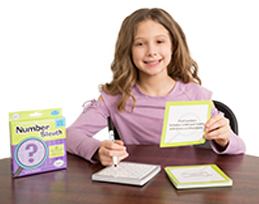
Number Sleuth holds the potential to help your students do just that. They can develop fluency with the skills and concepts inherent in number sense, while engaging them in a fun, competitive game or independent puzzle.
Number Sleuth helps students practice decomposition of number
Take a look at this example from the grade 2–3 game. Here students have to find ways to make 15. 7 and 8 is a solution. 6 and 9 is also a solution as well as 2, 9, and 4. 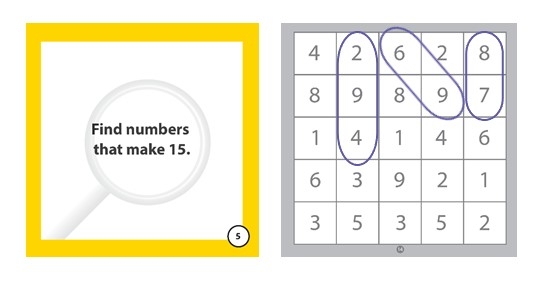 Of course, decomposing 15 is just one option. Students can take on challenges of decomposing 10, 20, and more. In later grades, Number Sleuth challenges students to decompose multi-digit numbers, decimals, fractions, and integers.
Number Sleuth helps students practice decomposition of number
Estimating and determining reasonableness is essential for developing computational fluency. This challenge from the grade 4–5 game has the player think about sums greater than 500. 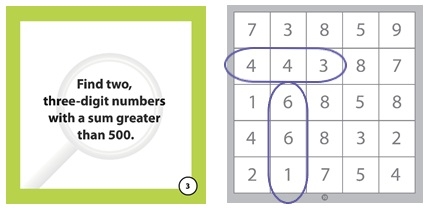 It gives him or her practice thinking about addends that will have sums greater than or less than a benchmark number. Here 344 + 166 is greater than 500. Other possibilities include 217 + 358 or 287 + 344. In other games, students estimate sums and differences relative to 50, 100, 1.00, or even –10 and –50 .
Number Sleuth practices skills students can be fluent with in later grades
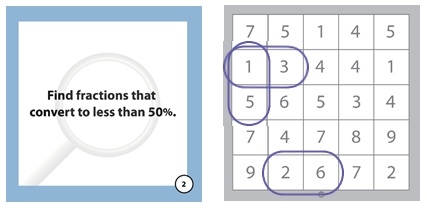
Estimating, decomposing, comparing, and finding sums, differences, quotients, or products form the foundation for students’ fluency with more advanced concepts. But we should expect to develop number sense with those concepts. Those topics include finding equivalent ratios, operating with integers, and finding percent. The latter is highlighted in this example from the grade 6–8 game. Here, a student is challenged to find fractions that convert to less than 50%. As with any number card in the game there are all sorts of solutions waiting to be found. Here, viable options include 2/6, 1/3, 2/7, or 1/5. But there are even more interesting solutions lurking below the surface. Consider for a moment that 14/44 and 24/76 are also solutions when students begin to think about fractions with multidigit numerators and denominators.
The variety of challenges support the variety of math ideas that students need to play with. It gives students a chance to see the potential of numbers and, more importantly, themselves. It’s the perfect center, independent practice, or game break. And there are a variety of game parameters to keep it fresh and inviting. For example, it could be timed or untimed like popular board games. A target number or solutions can be set, or the ways in which solutions are found can be limited. This too is essential because practice must be novel and engaging. After all, number sense develops through consistent practice and play.






 © 2025 Didax, Inc. All Rights Reserved.