Receive FREE SHIPPING on orders over $99 placed on the Didax website and shipped within the contiguous US. No promo code is required to receive this offer.
The order total for free shipping is calculated after any discounts are applied. Orders containing any Eureka Math, Big Ideas, Zearn, Math Perspectives, Didax Classroom and/or Investigations Kits DO NOT qualify for free shipping.
Free shipping valid ONLY on orders placed on the Didax website shipped within the contiguous US. Our regular shipping policies applies to other orders.
Receive FREE SHIPPING on orders over $99 placed on the Didax website and shipped within the contiguous US. No promo code is required to receive this offer.
The order total for free shipping is calculated after any discounts are applied. Orders containing Eureka Math Kits DO NOT qualify for free shipping.
Free shipping valid ONLY on orders placed on the Didax website shipped within the contiguous US. Our regular shipping policies applies to other orders.
Need new ideas? Looking for quick tips for teaching tricky concepts or organizing your math centers? Class Ideas is your go-to spot for inspiration, information and innovation and it’s an ideal way to stay current with the latest trends in math teaching and learning.
Share Your Ideas with Us
If there are topics you’d like us to cover or you’d be interested in being a guest contributor, reach out to us and we’ll respond. Email us at hello@didax.com
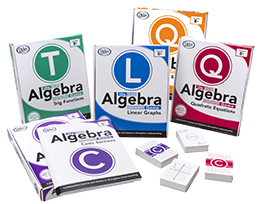
I taught an Algebra 1 or Algebra 2 class every year I was teaching, and I was always looking for ways to make the content engaging for the students. I firmly subscribe to John Van de Walle’s notion that drill and practice are two very different things, and sought opportunities for the students to have meaningful practice with the concepts they were learning. As a result, I avoided the lengthy problem sets and worksheets that are prolific in high school math classes, opting instead for problems, explorations, and games that encouraged thinking and discussion.
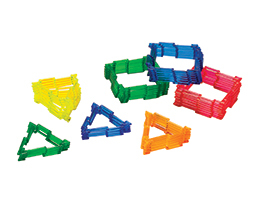
One of the things I really enjoyed about my Geometry classes in college was that they were very hands-on. We used a variety of manipulatives to explore geometric concepts, and the lessons have stayed with me for a long time now. I carried many of these ideas into the classroom when I started teaching, using ideas as simple as nets and tools like marshmallows and toothpicks. While these models are adequate for teaching the general ideas, they lack the consistency and formality that Geofix shapes offer.
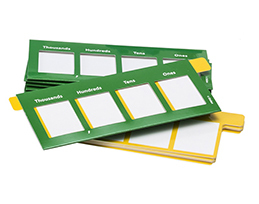
When I was teaching high school, place value was a concept that just seemed to exist; it was inherent in everything I taught, yet received little attention. I simply took it for granted. As I transitioned to working with students and teachers in the elementary grades, I realized that this was a mistake because place value was a concept that many of my students probably never fully understood. Place value is far more than just ones, tens, and hundreds. To really understand the concept of place value, we need to understand the relationship between the places.
According to the American Statistical Association, "Effective prediction is essential to improving medicine; monitoring climate; providing sufficient, safe food supplies; and much more." To make educated predictions as adults, children need to understand probability -- and start learning about it at an early age. Prediction is an adult skill used in many professional fields, including science, medicine, finance, and insurance. Underlying prediction is the notion of probability: whether a given event is certain to happen, likely, unlikely, or impossible.
As an undergraduate education student, I was challenged to write my personal mission statement that would help me define myself as a teacher. I don't recall the entire statement, but I know that it included something along the lines of "helping students think critically about mathematics." Looking at this from an experienced perspective, I'm not convinced that I knew what critical thinking was, let alone how to help my students become critical thinkers. With time, I've come to understand that there is no one way to accomplish this task, but there are strategies we can implement that will help students develop these skills.
From a very young age, children learn and develop using all their senses. As infants they are surrounded by the stimulation of shape, color, lines, numbers, patterns, and textures. By the time they reach preschool, they are engaged in stories and imaginative pursuits that build on these sensory explorations. Thanks to the materials they have explored in their first five years, children already have a strong foundation for mathematics when they start kindergarten.
When working with math teachers at any level, one of the complaints I've heard over and over begins with the phrase, "If they only knew their facts..." Fluency with basic facts, however, is only one part of a bigger picture, and I always encouraged teachers to think about the conceptual foundation they were building rather than how quickly students can rattle off some facts. As we consider the increased emphasis on rigor, we need to keep in the back of our minds what rigor is: a balance between conceptual understanding, application, and procedural fluency.

 © 2025 Didax, Inc. All Rights Reserved.