Receive FREE SHIPPING on orders over $99 placed on the Didax website and shipped within the contiguous US. No promo code is required to receive this offer.
The order total for free shipping is calculated after any discounts are applied. Orders containing any Eureka Math, Big Ideas, Zearn, Math Perspectives, Didax Classroom and/or Investigations Kits DO NOT qualify for free shipping.
Free shipping valid ONLY on orders placed on the Didax website shipped within the contiguous US. Our regular shipping policies applies to other orders.
Receive FREE SHIPPING on orders over $99 placed on the Didax website and shipped within the contiguous US. No promo code is required to receive this offer.
The order total for free shipping is calculated after any discounts are applied. Orders containing Eureka Math Kits DO NOT qualify for free shipping.
Free shipping valid ONLY on orders placed on the Didax website shipped within the contiguous US. Our regular shipping policies applies to other orders.
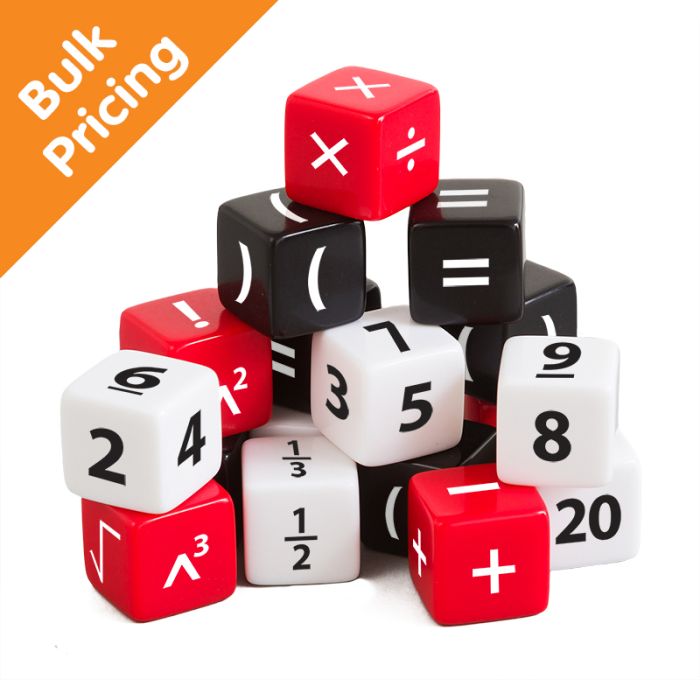
PEMDice, the “Order of Operations Game,” is an excellent resource for expanding mathematical thinking in a fun, engaging way. It is a perfect fit for kids at home who enjoys a challenge at any level. It can start simply, and evolve into a remarkably complex puzzle.
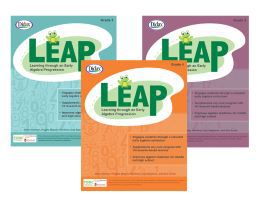
What brought you to this project? Why did you think there was a need for an early algebra curriculum?
We recognized that, generally, students are not prepared for the kind of math that they are doing in middle school and high school, and that algebra is really the gatekeeper for post-secondary education and entering the job market. We found that by spending just a little bit of time building early algebraic concepts in elementary grades, we can significantly improve children’s algebra readiness as they enter middle grades, and this has the potential to transform their success in school mathematics.
The Linear Graphs Algebra Game is an interactive way to teach key algebra concepts to your students in grades 8+. This card game has 12 sets of matching cards, each set includes 6 cards showing multiple representations of the same equation. This is a great tool to use in a small group or whole class.
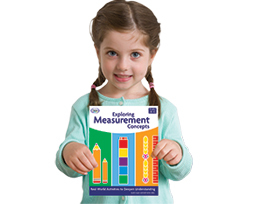
Primary children are expected to learn to count, add/subtract, and solve simple word problems in mathematics. So why must a focus at this level also include measurement concepts and skills? Obviously, measurement is of great importance in our daily lives. Those who have worked with K-3 students know that measurement topics are not easy for many children to understand. Measurement must be a focus at the primary level because students need a wide variety of conceptual experiences to make sense of what they are learning; this emphasis prepares them for later work in mathematics.
When first introduced to fractions, students in the intermediate grades sometimes struggle to make sense of equivalence and fraction operations. By helping students develop a deep understanding of the role of factors in comparison and fraction operations, we also prepare them for topics that follow and that build upon this knowledge.
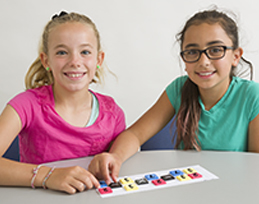
Many of the tools used to introduce these early fraction concepts can also be used later to help students recognize the relationships between fractions and ratios, rates, and proportions. Fractions with Prime Factor Tiles is the perfect tool to introduce and explore these concepts.
Helping students build an understanding of fraction concepts is a challenge in the intermediate and middle grades. The pictorial representation is a critical tool for making the connection between the concept and the procedure. Conceptual understanding occurs when students can explain why the procedure works, showing that they have assimilated or integrated this understanding into their basic knowledge of fractions.


 © 2025 Didax, Inc. All Rights Reserved.