
Fractions are Numbers, Too!
- By Kit Norris
- Nov 17, 2017
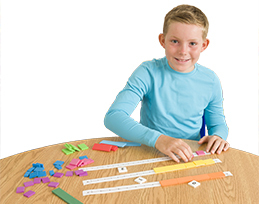
As I travel around the country working with teachers, I frequently hear, “My students just don’t like fractions.” Teachers are right, fractions are confusing. Let’s explore the foundational understandings and possible misconceptions that students may go through as they are learning about fractions. As articulated in the progression on “Number and Operations-Fractions, 3-5,” fractional understanding begins in Grades 1 and 2 as students partition shapes. This is certainly a logical beginning as students have had experiences identifying when their share is smaller than someone else’s! In Grade 3, students begin considering breaking a whole into equal parts. Students work with wholes that are varying shapes such as rectangles or circles and the focus is placed on equal parts. The emphasis in Grade 3 is on unit fractions (i.e., fractions having 1 as the numerator). Just as our whole numbers are composed by combining 1s, fractions can be similarly constructed by combining unit fractions. For example, ¾ = ¼ + ¼ + ¼.
 © 2025 Didax, Inc. All Rights Reserved.